
Committee hears calls for right to healthcare
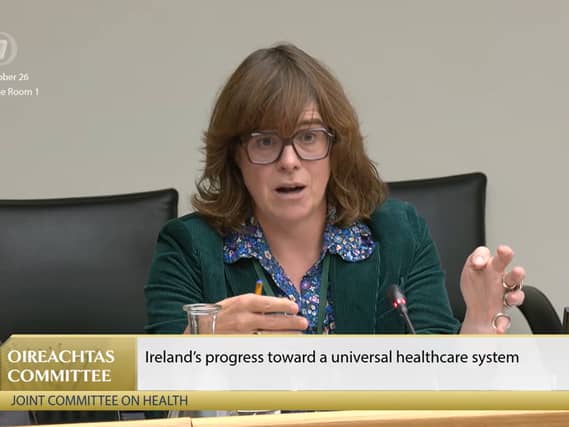

The Oireachtas Health Committee met on Thursday to assess Ireland’s progress towards the Sláintecare universal healthcare system.
Sláintecare will not be realised without a legislated right to healthcare, a committee has heard.
The Oireachtas Health Committee met on Thursday to assess Ireland’s progress towards the Sláintecare universal healthcare system.
Contributors, questioned by committee chairman Social Democrat TD Padraig Rice, also discussed the legislative right for healthcare, which Professor Steve Thomas described as “very empowering” for citizens to understand their entitlements.
Prof Thomas, of the Centre for Health Policy and Management at Trinity College Dublin, said the lack of an existing legislative right was hampering momentum.
The 2017 Committee on the Future of Healthcare report recommended a legislative basis for a universal “entitlement” to a broad package of health and social care.
Dr Sara Burke, director of the centre, added: “That was the original recommendation from the Oireachtas committee, but if you look at every single Sláintecare report since then – and there are dozens of them – none of them mention the legislation.
“And for me, that’s it being captured by the Department of Health, and this conservatism or reluctance to do that, and unless it’s legislated for, it won’t be realised.”
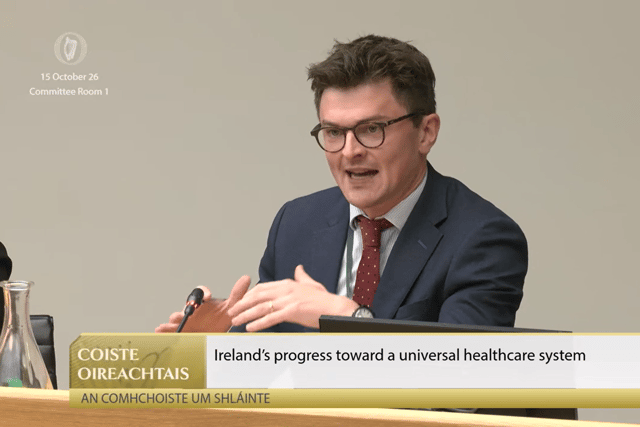
Elsewhere at the committee, Dr Domhnall McGlacken-Byrne, of Doctors for Universal Healthcare, said Irish public and private hospital systems “continue to overlap in a way that is complicated, inefficient, and unfair”.
He said: “We remain the only country in Europe without primary care, where a majority of citizens still pay in full and out of pocket to see a GP.
“Despite record recent health spending, half of Irish people feel the need to pay for private health insurance.
“In return, we get systems of care which too often are overburdened, fragmented, and difficult to access – this is a bad deal.”
He added: “Policy is guided by values, and our problems in health are inextricable from a political context in which healthcare in this country is not regarded as a basic right of all people.”
Dr McGlacken-Byrne said the question around universal healthcare should “not be whether we can afford to do this, but whether we can afford not to”.
He told the committee: “As a society, we need to talk about what this could look like, we must clarify the values which we want our health system to represent.
“To achieve universal healthcare, we need to make a collective commitment to healthcare as a human right of all people, and not something which a person must be deemed eligible to receive.”
Dr McGlacken-Byrne said he was recently speaking to a consultant who posited that universal healthcare would only be achieved through a combination of a taoiseach and health minister “forcefully behind it” coupled with “public anger and public pressure”.
He said: “I often think that the average person, voters, citizens, aren’t empowered to engage with the health system as though it is ours.”
He added: “There’s that power in the idea of our health services being ours rather than something that happens over there, which is kind of up on a hill and disconnected and impenetrable.
“It needs to be participatory, deliberative, and civic, in order to have that pressure, in order to have change. There’s no easy way to crack that nut.”